

From Hiring to the Front Line:
Where AI Goes Next in Retail and Food Service
AI has already changed how companies recruit. It can screen resumes, schedule interviews, answer candidates’ questions, and help employers move applicants through the hiring process faster.
But hiring is only the beginning.
Once someone joins the company, a different set of challenges begins: getting new employees up to speed, helping them handle day-to-day tasks, reducing administrative work, and creating an environment where they are more likely to stay.
This shift is particularly significant in retail and food service, where frontline employees perform hundreds of routine tasks every day. Many of these tasks are simple individually, but become operationally significant at scale.
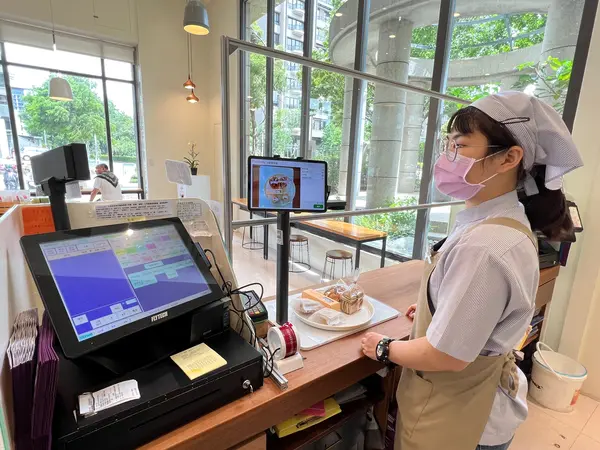
A bakery cashier may need to identify freshly baked products that have no barcode. A cafeteria employee may need to quickly identify the dishes on a customer’s tray. Restaurant staff may process hundreds of freshly prepared meals during a busy service period. In some dining environments, the price of a meal may even depend on the bowls or plates used.
The question for operators is increasingly straightforward: Which tasks need human judgment, and which can technology handle or assist with?
That question is pushing AI beyond recruitment and deeper into everyday work.
AI Has Already Changed the Hiring Process
The first wave of AI adoption has focused on recruitment.
Job seekers start using generative AI to refine resumes, write cover letters, and prepare for interviews. Employers are using AI on the other side of the process to handle growing volumes of applications and automate tasks.
According to Workday’s Global Workforce Report, 77% of organizations surveyed planned to increase their use of AI in recruiting over the following year. Applications included resume screening, candidate skills assessments, and other repetitive recruiting activities 1.
The restaurant industry provides a clear example.
In 2024, U.S. restaurant chain Chipotle Mexican Grill introduced a conversational AI recruiting system from Paradox. Its AI-powered virtual recruiting assistant, “Ava Cado,” could communicate with applicants, answer questions about the company, collect basic information, schedule interviews, and send offer notifications to selected candidates. The system was expected to roll out across more than 3,500 restaurants, with a goal of reducing store position recruitment time by up to 75% 2.
By 2025, Chipotle reported measurable results. The average time between completing an application and starting work had fallen from 12 days to 4. The application completion rate rose from roughly 50% to more than 85% Note 1, while the number of applicants nearly doubled 3.
Recruiting, however, is only one part of the workforce challenge.
The National Restaurant Association continues to identify hiring and retention as major concerns for restaurant operators 4. At the same time, technology is expanding into areas such as onboarding, training, scheduling, and employee management—potentially reducing administrative demands on managers and giving them more time to focus on their teams and operations 5.
But recruiting is only the beginning. Once someone joins the team, businesses face a different challenge: how quickly can a new employee get up to speed, and what helps them stay?
What Happens After the Hire?
Once a new employee joins the team, businesses need to invest time and resources in helping them learn the job and the operation, understand products and procedures, and become comfortable handling their responsibilities independently.
The National Restaurant Association’s 2026 research estimates that hourly restaurant employees take an average of 31.8 days to reach “net positive” value, while managers and salaried employees take an average of 72.2 days.
For restaurant operators, the implication is practical: the sooner a new employee can work independently, the sooner the business can begin to realize the value of that hire 4.
Technology is already playing a role in shortening this learning curve. NRA research shows that businesses are using digital tools to improve onboarding, training, scheduling, and employee management 5.
One particularly relevant application is AI-powered visual recognition.
When Employees Don’t Have to Memorize Every Product
In a typical convenience store, many products already come with a barcode. The employee scans the package, and the POS system identifies the item.
Fresh food is different.
A freshly baked croissant, a red bean bun, a slice of cake, or a prepared dish may have no barcode at all. Employees need to recognize the product themselves, often from a large assortment of visually similar items.
For an experienced employee, that knowledge may become second nature. For someone new to the job, however, learning dozens or hundreds of products can take time.
AI-powered visual recognition can shift part of that burden from the employee to the system.
Instead of requiring a new cashier to memorize every product before working independently, the system can assist with product identification during checkout. Employees can begin handling real transactions while continuing to build their product knowledge on the job.
RT Baker House in Hsinchu, Taiwan, has used an AI-powered checkout system since 2022. The bakery reported that, in addition to improving checkout speed, the system helped reduce the time required to train new employees. Training that previously took one to two months could be completed in one to two weeks after the system was introduced 6.
The underlying idea is simple: employees still operate the checkout, but AI assists with one of the tasks that traditionally required extensive product knowledge.
The same approach can extend beyond bakeries.
In restaurants and cafeterias, visual recognition can be used to identify prepared foods such as bento and other dishes. Where pricing is based on the bowls or plates selected by customers, AI can also recognize the tableware/containers themselves.
Each individual task may seem minor. But frontline work is made up of hundreds of such tasks every day.
A product that no longer needs to be searched manually.
A POS entry that no longer needs to be typed.
An item that no longer needs to be identified from memory.
At the scale of a busy store or restaurant, removing small points of friction can make a meaningful difference to the employee experience.
Retaining Talent Begins within an Employee’s First 90 Days
Getting employees through training is not the end of the workforce challenge.
The next question is whether they stay.
The National Restaurant Association identifies the first 30 to 90 days as an important period for employee retention. Structured onboarding, regular interaction with managers, mentorship, and clear opportunities for development can all influence how successfully new employees settle into their roles.
This is where the relationship between technology and retention becomes more interesting.
Technology cannot create a strong manager-employee relationship. Nor can automation replace good onboarding, coaching, or a sense of belonging.
But it can change how managers and employees spend their time.
When technology takes care of some repetitive tasks or administrative work, managers may have more time for the work that requires human attention: coaching new employees, answering questions, providing feedback, and building stronger relationships within the team.
That distinction matters.
The goal is not simply to automate more work. It is to determine where technology can remove friction so people can spend more time on the work that benefits from people.
NRA research similarly emphasizes that human interaction remains an important part of recruiting, onboarding, and retention, even as restaurants adopt more automation and digital tools 4.
AI Is Moving From the Hiring Process to the Work Itself
The evolution of AI in retail and food service is therefore not just about recruiting. The first question was: How can AI help companies find people? The next is: How can AI help those people do their jobs?
That can mean helping a company process applications faster. It can mean shortening the time required to train a new employee. It can mean assisting a cashier in identifying fresh food without barcodes. Or it can mean taking repetitive administrative tasks off a manager’s plate.
None of these applications eliminates the need for people. Instead, they change where people spend their time and what they need to learn in order to perform their jobs effectively.
That also changes the way businesses should think about employee retention.
Retention does not begin when an employee hands in a resignation. It starts much earlier—in the onboarding process, in the first weeks on the job, in the daily experience of getting work done, and in the amount of time managers have to support their teams.
For bakery and food service operators, the next phase of AI may therefore be less about finding more people and more about making frontline work easier to learn, easier to perform, and easier to manage.
[References]
1 “Workday Global Workforce Report: Job Market Tightens as AI Reshapes Hiring Processes.” Workday. https://newsroom.workday.com/2024-09-10-Workday-Global-Workforce-Report-Job-Market-Tightens-as-AI-Reshapes-Hiring-Processes.
2 “CHIPOTLE INTRODUCES NEW AI HIRING PLATFORM TO SUPPORT ITS ACCELERATED GROWTH.” Chipotle. https://newsroom.chipotle.com/2024-10-22-CHIPOTLE-INTRODUCES-NEW-AI-HIRING-PLATFORM-TO-SUPPORT-ITS-ACCELERATED-GROWTH.
3 “CHIPOTLE AIMS TO HIRE FUTURE BILLION DOLLAR BUSINESS LEADERS IN NEW “BURRITO SEASON” HIRING PUSH.” Chipotle. https://ir.chipotle.com/2025-02-19-CHIPOTLE-AIMS-TO-HIRE-FUTURE-BILLION-DOLLAR-BUSINESS-LEADERS-IN-NEW-BURRITO-SEASON-HIRING-PUSH.
4 “Research Insight: Hiring-and-Staffing. How Onboarding, Managers, & Technology Drive Restaurant ROI.” National Restaurant Association. https://www.restaurant.org/research-and-media/research/research-reports/research-insight-workforce-hiring-staffing/.
5 “Research Insight: Workforce Technology. Transforming Restaurant Recruitment & Retention: Leveraging Technology in a Shifting Workforce Landscape.” National Restaurant Association. https://restaurant.org/research-and-media/research/research-reports/research-insight-workforce-technology-report/.
6 “How RT Baker House Responded to Declining Birth Rate in Taiwan.” Viscovery. https://viscovery.com/en/how-rt-baker-house-responded-to-declining-birth-rate-in-taiwan/.
Note 1 Application completion rate refers to the percentage of candidates who begin an application in the recruiting system and ultimately complete and submit the full application form.