

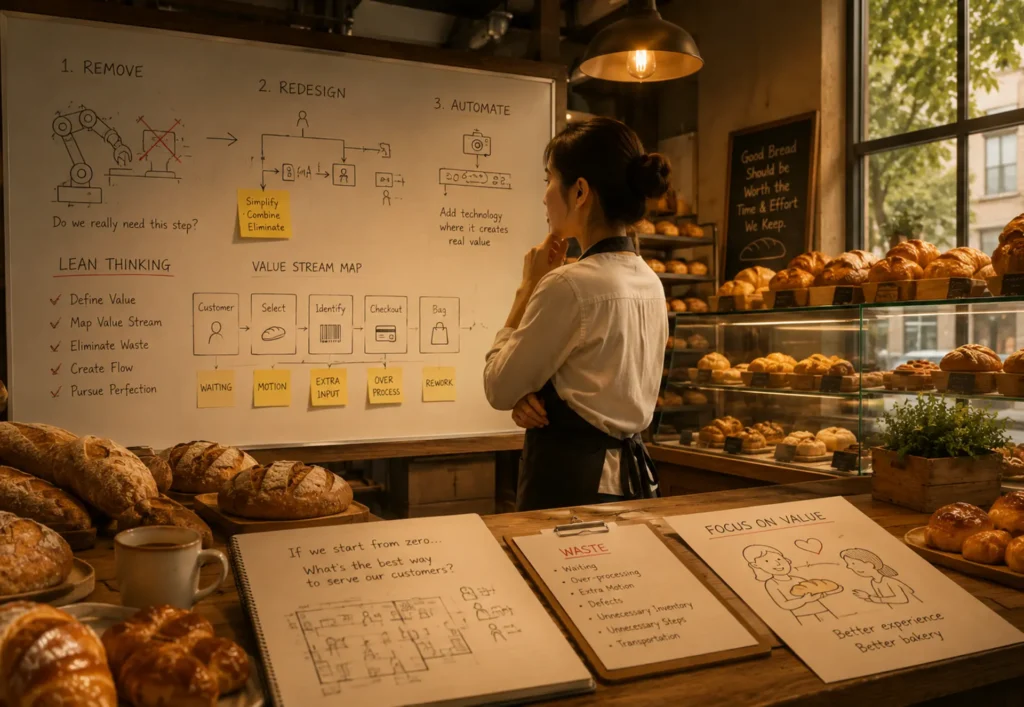
Before Automating:
Rethinking Bakery Operations from the Ground Up
Rethinking AI Transformation in Bakeries
As AI, self-checkout, and other automation technologies make their way into bakery retail, businesses are naturally asking what they can automate. But there may be a more important question to ask first: Which tasks should not exist in the first place?
Labor shortages and rising labor costs are pushing retailers to automate work that once required a lot of human effort. Reuters recently reported on the growing use of automation in South Korea, where a shrinking workforce and rising labor costs are driving coffee shops, restaurants, and other retailers toward self-service and unmanned operations 1.
For many businesses, automation is no longer simply about improving efficiency. It is becoming part of a broader strategy for dealing with a changing labor market.
Therefore, businesses usually start with the tasks that require the most time and effort:
- Which tasks take the most time?
- Which tasks can AI handle?
But there is a problem with that approach. It assumes the existing process is worth keeping. A better question might be:
“If this store were designed from scratch today, would it be run this way?”
That question leads to a lesson from Tesla.
Sometimes the Best Way to Improve a Process Is to Eliminate It
Elon Musk shared a story from Tesla’s early days that shows this idea clearly.
At that time, a fiberglass mat needed to be placed on top of a battery pack. A costly robot picked up the mat and put glue on it, but the process had many problems. The robot’s suction cup often dropped the mat, and it was hard to control the amount of glue.
At first, the engineering team tried to fix the problems. They changed the robot’s programming, shortened its movements, and adjusted the glue. They just wanted to make the machine work faster and better.
Then, Musk asked a very simple question: “What is this mat actually for?”
It turned out that different groups had different ideas about the mat. This showed that the teams were not talking to each other.
They decided to test the battery pack with and without the mat. The result? The mat made no difference at all. So, they just removed it. Since the mat was gone, they did not need the expensive robot anymore either 2.
The important lesson here is not how to fix a robot. The lesson is that the robot should never have been doing that job.
This is a big difference. When companies want to improve a process, they usually try to make each step faster, cheaper, or better. But sometimes, the best improvement is to remove the step completely.
Before you try to fix a process, always ask a basic question: “Why are we doing this at all?”
Making the Wrong Process More Efficient Is Still Waste
This idea is not just for Tesla. It is also the main point of “Lean Thinking.”
Lean is a way of managing a business. It focuses on creating value for customers while constantly removing waste. The goal is not just to make people work faster. It is to do more with less.
The Lean Enterprise Institute (LEI) explains waste very simply: it is any activity that uses up time or money but adds no value for the customer 3.
This is very important when companies start using technology.
Automation does not automatically eliminate waste. If a company does not look at how the work is actually done, technology will only perform an inefficient task faster. In other words, instead of eliminating waste, it ends up automating the waste 4.
This same problem can easily happen in a bakery.
Imagine a checkout process in which an employee has to identify each item individually, find the corresponding product in the POS system—perhaps navigating through different product categories—click the right item or manually enter a price, and then complete the remaining steps before taking payment.
When lines build up during peak hours, the obvious solutions might be to schedule more cashiers, open another POS terminal, or make the POS interface easier to use.
All of those solutions, however, leave one assumption untouched: the employee still has to look at and identify every single product.
If that is the part of the process that should actually be reconsidered, then adding staff or improving the POS only makes the existing workflow more efficient. It does not change the workflow itself.
And that is the difference between optimizing a process and rethinking it.
What Happens When You Automate Before Redesigning a Process?
McKinsey has shared an example that illustrates how quickly automation can become complicated when companies skip the planning step.
A professional services company wanted to reduce costs by automating the manual paperwork done by a 20-person team. On paper, it looked like a great opportunity: automating the work could potentially reduce labor costs by about 60%.
So, the company moved quickly into development.
However, challenges appeared when the team looked more closely at what the work actually involved.
The group served hundreds of clients, each with its own rules for forms and files. Even worse, the team had to use more than five different computer systems, each with its own transaction formats.
What initially looked like a straightforward automation project turned into a highly complex system, with hundreds of variations, frequent manual interventions by employees, and significant maintenance.
In the end, the project was abandoned. The IT department instead addressed the problem through more traditional systems integration 5.
The lesson is straightforward: a large automation opportunity on paper does not always mean an easy project in real life.
When companies focus too quickly on technology, they can end up automating processes that are inefficient, overly complicated, or no longer fit the business.
McKinsey suggests an alternative called “process clean-sheeting.” Instead of making small improvements to an existing process, start from scratch and ask what the process should look like if it were designed today 5.
That mindset is particularly relevant to bakery operations.
A bakery is not just a collection of separate tasks. Its operations are shaped by the interaction between products, equipment, POS systems, employees, and customer behavior.
If these relationships are not examined first, automation may simply move the complexity from one part of the operation to another.
Before Automating a Task, Look at the Entire Workflow
This is one reason Lean Thinking focuses on the value stream, rather than on individual workstations.
A value stream includes the entire flow of work required to deliver a product or service—from the initial customer demand all the way to completion. Value Stream Mapping (VSM) is a common Lean tool used to make that flow visible. It helps identify waiting times, unnecessary movements, repetition, handoffs, and other forms of waste 6.
Consider the checkout process in a bakery.
If checkout takes too long, the POS system may not actually be the main problem.
The real challenge could lie anywhere in the process between the moment a customer picks up a pastry and the moment payment is completed:
- How is the product identified?
- How does that product information get into the POS system?
- Where does an employee have to step in?
- Which steps exist only because an earlier part of the process has limitations?
Those questions can lead to very different solutions.
If the problem is defined as:
“Employees are too slow at identifying products and entering them into the POS,”
then the natural response is to improve the POS interface or provide additional training.
But if the problem is redefined as:
“Why does an employee have to identify every product at all?”
an entirely different solution becomes possible.
That is what process redesign is really about.
It is not simply about doing the same work faster. It is about reconsidering who should do the work, when it should happen, and how it should happen.
“If We Were Starting Over Today” May Be the Better Question
This is also where McKinsey’s zero-based approach offers a useful perspective.
A zero-based approach does not mean literally throwing everything away and starting over. It means temporarily setting aside existing budgets, staffing structures, tools, and routines instead of treating them as permanent limits.
The goal is to ask what the business actually needs today:
- Which activities still matter?
- Is the business operating at the same scale as when these processes were first created?
- Are the existing tools and data still appropriate for the way decisions are made today?
- Are people still using all the reports being produced?
- Do all of those meetings and recurring tasks still serve a purpose?
- Which activities exist simply because they have always been done that way 7?
For bakeries, this way of thinking can be particularly useful because many operational routines are built around habit.
- Why does an employee have to identify every product individually?
- Why does the same information have to be entered more than once?
And perhaps the most revealing question:
“If this bakery were opening today with no legacy systems, staffing structures, or established routines to work around, would the operation be designed the same way?”
The point is not to prove that the old way was wrong. It is to determine whether it still makes sense. The hardest waste for a business to find is usually not a clear mistake. Instead, it is a task that everyone keeps doing every day, even though no one remembers why it exists.
The Best Use of AI Is the Work Left After Redesign
Once a process has been examined and unnecessary steps have been removed, the remaining work becomes much more interesting for automation.
The question changes from “What can AI do?” to “Which tasks are actually worth giving to AI?”
Not every task in a bakery needs AI. The strongest candidates are tasks that happen frequently, are highly repetitive, cause frequent mistakes, and directly affect the customer experience.
Product recognition is a good example.
With AI image recognition, products can be identified automatically, and the results can be sent straight to the POS system.
At that point, AI does more than just replace manual work. It becomes part of a completely different checkout process.
This is how automation turns into process redesign. Instead of making the existing workflow faster, technology helps create a better workflow from the very beginning 8.
The Goal of Automation Is to Reallocate Human Time
There is one more question that often gets overlooked:
“If AI takes over part of the work, what should employees do with the time they get back?”
Automation does not necessarily mean reducing headcount. It can also change how employees spend their time and which skills become more valuable.
McKinsey’s research on retail has highlighted how automation can reshape the workforce. As processes change, companies also need to reconsider where human effort adds the most value 7.
If AI can save the time employees spend identifying products at checkout, the goal does not have to be simply having one fewer cashier.
Instead, the saved time can go toward helping customers, restocking shelves, making displays look attractive, or keeping the store running smoothly.
This may be the most meaningful promise of AI: it does not simply replace human work, but moves human time from repetitive tasks to work that truly benefits from human attention 8.
AI Automation Starts with Rethinking the Process
As AI, self-checkout, and other technologies continue to reshape bakery retail, lessons from other industries offer an important reminder:
The starting point for automation should not always be technology. It should be the process itself.
The Tesla example shows that sometimes the best improvement is to eliminate a step altogether. Lean Thinking reminds us not to automate waste. McKinsey’s research suggests that successful automation often begins with redesigning the process before building the technology around it.
For bakeries considering AI or automation, that means putting the technology question aside temporarily and asking a more basic question: “Why does this task exist?”
If a task creates no value, perhaps it should be eliminated. If it is still necessary, the process should be redesigned.
Only then does it make sense to ask whether AI or another automation technology can make that process better.
The ultimate goal of automation is not simply to do more with fewer people. It is to make better use of the people and resources you already have—placing them where they can create the most value.
(The featured image was generated using ChatGPT’s AI tools for illustrative purposes only.)
[References]
1 “South Korean shops turn to robots, self-service to escape labour woes.” Reuters. https://www.reuters.com/world/asia-pacific/south-korean-shops-turn-robots-self-service-escape-labour-woes-2026-07-02/.
2 “The Absurd Reason Why Tesla’s Model 3 Assembly Line Kept Getting Delayed.” Slate. https://slate.com/technology/2018/05/elon-musk-says-a-flufferbot-caused-the-model-3-delays.html.
3 “What is Lean?” Lean Enterprise Institute. https://www.lean.org/explore-lean/what-is-lean/.
4 “Ask Art: Is there a conflict between automation/IT and lean?” Lean Enterprise Institute. https://www.lean.org/the-lean-post/articles/ask-art-is-there-a-conflict-between-automation-it-and-lean/.
5 “How to avoid the three common execution pitfalls that derail automation programs.” McKinsey & Company. https://www.mckinsey.com/capabilities/tech-and-ai/our-insights/how-to-avoid-the-three-common-execution-pitfalls-that-derail-automation-programs.
6 “Lean Thinking and Practice.” Lean Enterprise Institute. https://www.lean.org/lexicon-terms/lean-thinking-and-practice/.
7 “Crafting a fit-for-future retail operating model.” McKinsey & Company. https://www.mckinsey.com/industries/retail/our-insights/crafting-a-fit-for-future-retail-operating-model.
8 “How AI Lets Humans Focus on What Only Humans Can Do” Viscovery. https://viscovery.com/en/how-ai-lets-humans-focus-on-what-only-humans-can-do/.