

Checkout Clicks Drop from 3,200 to 480:
How AI Lets Humans Focus on What Only Humans Can Do
We’ve long gotten used to “progress”—we just didn’t notice checkout was still stuck in place
Looking back at the past two decades of work, many things have quietly changed.
Engineers no longer manually deploy every server; automated workflows handle the process. Web and product designers don’t have to code every single screen from scratch—they can use intuitive design tools to quickly build interfaces. Customer support agents no longer handle every repetitive inquiry individually. With the system categorizing and responding automatically, the agents can focus on cases that require real understanding and human judgment.
What these changes have in common is simple: offload repetitive, attention-draining tasks to systems.
Yet in many bakeries and retail stores, the act of checking out still relies heavily on human hands.
Checkout Is Actually High-Intensity Work That’s Often Underestimated
Checkout might look like just “clicking a few buttons.” In reality, a single cashier faces:
- Each transaction may involve a tray of 4–5 items—or sometimes up to 9–10 different types of bread.
- On the POS system, every item must first be categorized, then selected individually.
- Each transaction can require 8–10 or more clicks.
At an average of 1.5–2 minutes per transaction, an 8-hour shift can mean a cashier clicks 1,900 to 3,200 times—and in a busy store, potentially 5,000 to 6,000 clicks.
These clicks require no thinking, no creativity, yet they add up to real strain on wrists, shoulders, eyes, and mental energy. The more clicks, the less attention a cashier can give to the customer in front of them.
AI-Powered Image Recognition Really Changes the “Role” of the Human
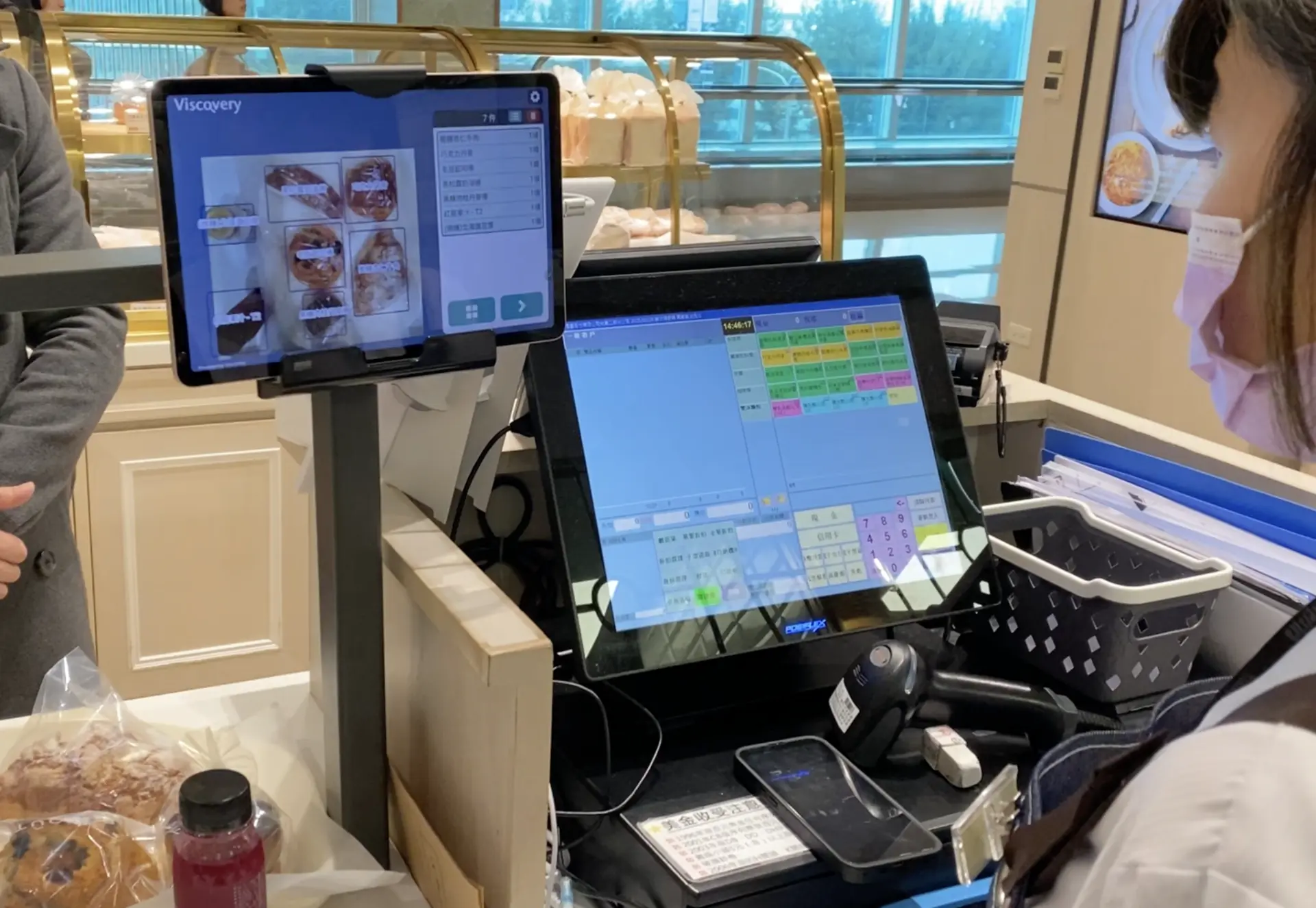
Introducing AI image recognition transforms the checkout process entirely.
No matter how many items are on a tray, once they’re placed under the camera:
- AI instantly identifies each item
- The system automatically pulls up the product
- The cashier simply confirms and submits with one tap
With AI streamlining the workflow, checkout drops to roughly 1 minute per transaction, allowing a cashier to serve about 480 customers in an 8-hour shift, with only 480 clicks.
Going from 3,000 clicks to 480, cashiers are freed from countless unnecessary actions.
It’s like GPS navigation: drivers no longer have to juggle reading maps while steering. Or voice-to-text: meetings no longer depend on who can type fastest. Technology’s value isn’t just speed—it lets humans work smarter, not harder, and maintain consistency under pressure.
Using Tools to Elevate Human Value
When cashiers aren’t tied down by repetitive clicking, they can focus on:
- Responding to customer questions
- Proactively advising on product storage or care
- Monitoring lines and adjusting store flow
- Helping restock, arrange displays, and check quality
- Maintaining calm and attentive service even during peak hours
These are all things a system, computer, or AI cannot do—yet they’re exactly what customers expect from a physical store.
AI doesn’t replace humans. Instead, it allows people to hone and apply skills that only humans can deliver: judgment, communication, service, and on-the-spot problem solving.
The real difference AI makes isn’t saving a few seconds per transaction—it’s that cashiers no longer spend an entire day on thousands of meaningless taps.
And this is only the first step. In the next article, we’ll explore how AI systems help store managers quickly respond to unexpected staffing shortages while keeping operations and service smooth and consistent.
Further Reading: