

AI Is Reshaping Food Service:
Better Customer Experiences Start With Better Employee Experiences
As dining out becomes more expensive, the question for consumers is no longer simply how much a meal costs. Increasingly, they want to know whether the experience is worth the price.
That shift is changing what restaurants need to deliver. Good food remains the foundation, but the value of a meal is gradually shaped by everything around it—the setting, the service, the interactions, and the overall experience.
Taiwan offers a useful example of how quickly this shift is taking hold. According to the 2026 report The Experience-First Dining Revolution: How Atmosphere and Aesthetics Can Ease the Pressure of Rising Prices (2026體驗先行的餐飲革命:氛圍美學如何削減漲價壓力), online discussion of Taiwan’s food service industry grew from more than 230,000 posts in 2023 to more than 300,000 in 2025. Shares of posts related to experience-driven dining rose even more sharply, from 74,321 in 2024 to 243,563 in 2025 1.
The numbers point to a broader change in how people think about dining out. What matters is increasingly not just what they eat, but how the experience makes them feel.
Restaurants are responding with themed spaces, tableside interactions, brand collaborations, and other ways to make a meal memorable—and worth talking about afterward. As competition shifts toward experience, however, that experience is no longer confined to the dining table. It begins when customers walk through the door and continues through ordering, pickup, and payment.
But there is another part of the experience that is easy to overlook: the people delivering it.
The Customer Experience Starts with the People Behind It
For restaurant operators, the quality of a customer’s experience is closely tied to what happens on the other side of the counter.
Frontline employees work within those same touchpoints every day. The complexity of their workflows, the amount of repetitive work they handle, and the time they have to pay attention to customers all shape how they experience the job. It also matters whether they have enough room to make decisions, solve problems, or simply take pride in what they do.
Will Guidara, the former co-owner and general manager of Eleven Madison Park, has spoken about the tension between pursuing excellence and keeping employees engaged. During his time at the restaurant, which reached No. 1 on The World’s 50 Best Restaurants list under his leadership, he saw how complex systems and heavy workloads could push even a high-performing team toward burnout and mistakes 2.
His experience suggests that high standards are only part of the equation. The work itself also needs to leave room for engagement, enjoyment, and a sense of ownership—so employees have a reason to stay invested in what they do 2.
For Guidara, great hospitality was never simply about following a flawless process. Some of the most memorable moments happened when employees had enough freedom—and enough bandwidth—to do something unexpected 2.
He has shared one example from his time as general manager: he overheard a table of European diners mention that one of their biggest regrets about visiting New York was leaving without trying a hot dog. Rather than letting the comment pass, he went out onto the street, bought one, and brought it back to the table during their meal 3.
The hot dog itself was hardly the point. What mattered was that someone was paying attention—and had the time and freedom to act on what they noticed.
When employees have the capacity to observe, think, and improvise rather than simply work through a list of tasks, service can become more personal and responsive.
The same principle applies across food service. Whatever the format of the operation, frontline employees are constantly balancing operational demands with customer needs.
That raises a simple question: How can businesses preserve people’s limited time and attention for the moments that genuinely require a human touch?
As Dining Becomes More Self-Service, Checkout Becomes Part of the Experience
That question takes on a different form in self-service dining—from workplace and school cafeterias to hospital dining halls, factory canteens, and the buffet-style restaurants.
Customers may serve themselves, but checkout often remains highly dependent on frontline employees. Unlike packaged retail products, many prepared dishes have no barcode. A single tray may contain several different items, leaving the cashier to identify each one visually before ringing it up.
Under normal conditions, that may be manageable. At lunchtime, when trays arrive one after another, it becomes a very different problem.
A process that takes only a few seconds per customer can create a bottleneck when repeated hundreds of times. For employees, it also means spending a significant part of the shift performing the same visual identification and data-entry tasks over and over.
As technology automates more parts of food service operations, checkout is also becoming an area where technology can help create a more seamless experience.
That is where AI can begin to play a role.
AI Can Take on the Repetition. People Can Focus on the Service.
AI-powered visual recognition offers one way to address this challenge.
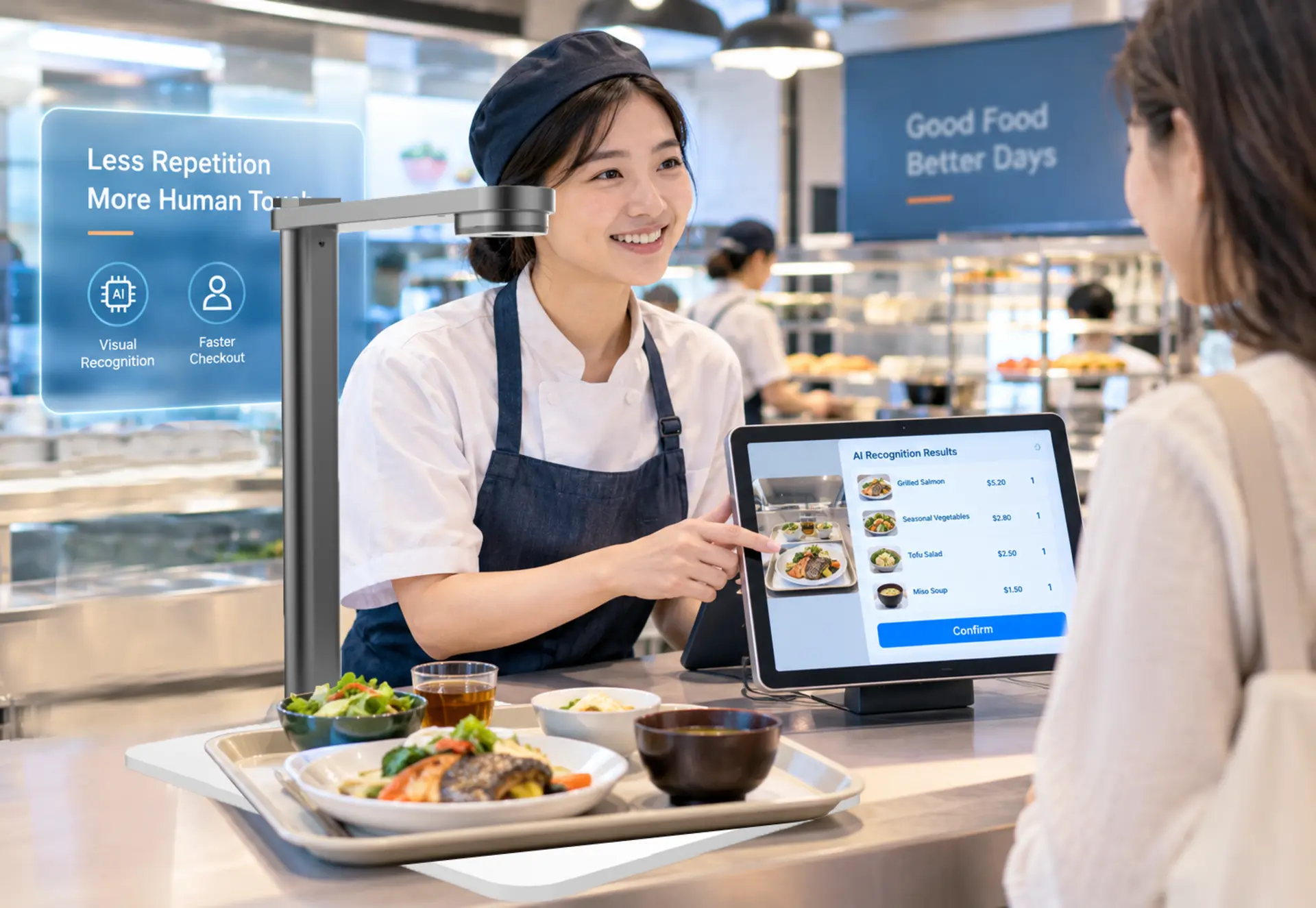
A camera at the checkout counter can identify dishes, prepared meals, freshly baked goods, and other items on a tray. An employee can then verify the results before completing the transaction. In more advanced self-service environments, the same technology could eventually allow customers to confirm their own selections 4.
The immediate benefit is straightforward: less time spent identifying items at checkout.
But the bigger opportunity is what happens to the time that is freed up.
When AI handles repetitive identification and data entry, employees can spend more of their attention on the situations that still require human judgment—helping a customer, resolving an unexpected issue, answering a question, or noticing something that falls outside the system’s understanding.
That changes the role of automation.
The goal does not have to be to remove people from the service experience. It can be to remove some of the work that keeps people from participating fully in it.
For customers, that can mean a faster, smoother checkout. For employees, it can mean fewer repetitive tasks and more time for the parts of the job that actually involve serving people.
What AI Gives Back to the Front Line
The more interesting question is not how much work AI can take on, but what people can do with the time it gives back.
When technology handles repetitive tasks, employees have more room to pay attention, make decisions, solve problems, and create the moments that turn a transaction into good service.
For an industry built around human interaction, that may be where the real value of AI lies.
(The featured image was generated using ChatGPT’s AI tools for illustrative purposes only.)
[References]
1 〈2026體驗先行的餐飲革命:氛圍美學如何削減漲價壓力。〉網路溫度計。https://dailyview.tw/insight/detail/97.
2 〈追求卓越,團隊卻快撐不住…最佳餐廳推手:留意3個超載警訊,讓工作變有趣。〉104。https://blog.104.com.tw/team-burnout-warning-signs-make-work-fun/.
3 〈米其林三星餐廳買「街邊」的熱狗堡出餐,為何反而受到顧客喜愛?麥迪遜公園 11 號的故事。〉經理人。https://www.managertoday.com.tw/articles/view/67931.
4 “AI Revolutionizes Haidilao “Hi Noodle” Self-Checkout Experience.” Viscovery. https://viscovery.com/en/ai-revolutionizes-haidilao-hi-noodle-self-checkout-experience/.