

South Korea’s Unmanned Store Boom:
How AI Is Reshaping Retail and Food Service in an Era of Labor Shortages
Around the world, labor shortages are no longer a temporary challenge—they’re becoming the new normal. As populations age and birth rates continue to decline, businesses are finding it harder to hire enough workers. The question is no longer how to recruit more employees, but how to enable a smaller workforce to accomplish more without compromising service quality.
Few countries illustrate this shift more clearly than South Korea. As one of the world’s fastest-aging societies, the country offers a glimpse into how retailers and food service operators are adapting to a shrinking labor force.
According to Reuters, South Korea’s population is projected to decline from roughly 51.8 million today to about 36.2 million by 2072. Facing long-term workforce shortages, many businesses are turning to self-service technologies, automation, and AI to reduce their reliance on manual processes 1.
Unmanned Stores Are Expanding—and So Is AI
Reuters reports that South Korea had approximately 9,000 unmanned stores by the end of 2024. Samsung Card estimates that the number of unmanned stores in 2025 will be roughly four times higher than it was in 2020 1.
These businesses range from self-service cafés and ramen shops to flower stores, pet supply retailers, and clothing boutiques 1.
Faced with growing hiring challenges and rising labor costs, many businesses have adopted self-service technologies to keep operating with leaner teams. Self-order kiosks, cashless payments, robots, and remote management systems now enable many stores to stay open 24 hours a day with little or no staff on site 1.
In this environment, every operational decision matters. Investing in AI is no longer about embracing the latest technology—it’s about staying competitive. As a result, AI, robotics, and self-service solutions are becoming standard tools for modern retailers.
AI Doesn’t Replace Employees—It Helps Them Work More Efficiently
When people hear about automation in retail or food service, they often imagine fully unmanned stores. In reality, many businesses are taking a more practical approach: using AI to support employees rather than replace them.
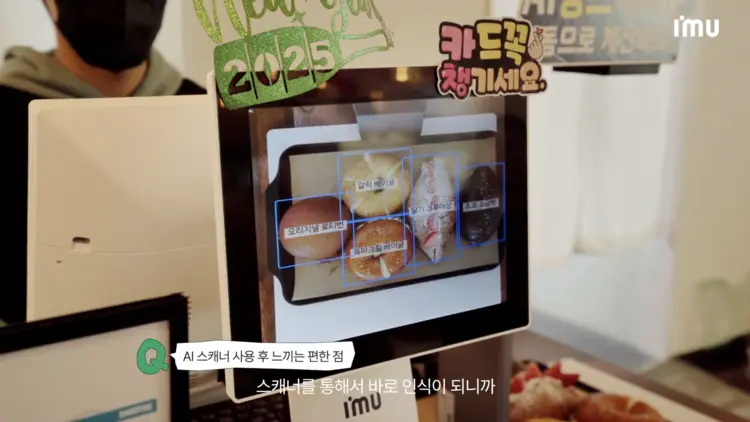
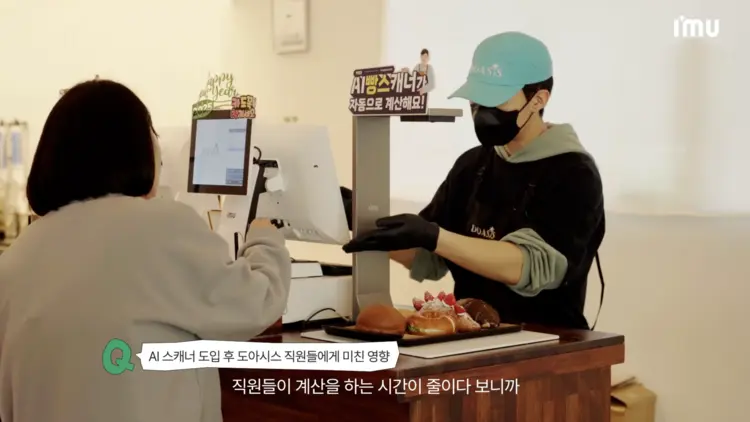
Some bakeries in South Korea, for example, have begun deploying AI-powered visual checkout systems. Customers simply place their tray on the checkout counter, and the AI instantly identifies every bakery item, allowing staff to complete the transaction quickly and accurately 2.
The benefits include:
- Faster checkout and shorter lines during busy hours
- Fewer pricing and item identification errors
- A more streamlined checkout workflow (Less manual work for checkout staff)
- Faster onboarding and shorter training for new employees
With AI handling product identification, even newly hired employees can quickly process a wide variety of unpackaged bakery items. For bakeries that sell dozens—or even hundreds—of different products each day, AI functions less like a replacement for staff and more like an extra set of hands that’s always available.
Automation Is About More Than Cutting Labor Costs
Automation is often viewed as a way to reduce payroll expenses. Increasingly, however, retailers and restaurant operators are investing in automation for a different reason: to improve operational efficiency and deliver a better customer experience.
AI-powered visual checkout is a good example. By taking over repetitive, rules-based tasks such as product identification, AI frees employees to focus on work that requires human judgment, problem-solving, and customer interaction. Instead of spending valuable time on routine work, staff can devote more attention to creating a better customer experience—something technology alone can’t deliver.
AI also makes it easier to bring new employees up to speed. Faster training means businesses can reduce the time and management effort required whenever new staff join the team or existing employees leave.
The benefits extend beyond the business itself. Customers spend less time waiting in line, checkout becomes smoother, and the overall shopping experience improves—all of which strengthen customer satisfaction and brand perception.
The real goal of automation has never been to eliminate people. It’s to help every employee create more value.
Further reading: Checkout Clicks Drop from 3,200 to 480: How AI Lets Humans Focus on What Only Humans Can Do
Further reading: How Starbucks, DHL, and Ijysheng are using AI to free staff for more meaningful work
AI Is Becoming Part of Everyday Retail and Food Service Infrastructure
Not long ago, AI was considered cutting-edge technology. Today, it’s gradually becoming as commonplace as POS systems, payment terminals, and barcode scanners—just another part of everyday retail operations.
South Korea’s rapidly growing network of unmanned stores and the increasing adoption of AI-powered checkout in bakeries point to the same trend. AI is moving beyond technology demonstrations and becoming a practical solution for addressing labor shortages, improving operational efficiency, and delivering a better customer experience.
AI may not replace store employees entirely. But businesses that use AI to amplify the capabilities of their workforce are likely to outperform those that continue relying on labor-intensive processes. As labor shortages become a long-term reality, one of the industry’s biggest competitive advantages will be knowing how to use technology to empower frontline employees—not burden them.
Further reading: The Rise of AI-Powered “10x Professional” in the Bakery Industry
Further reading: Stop Wasting Time on Tasks That Don’t Need to Be Manual
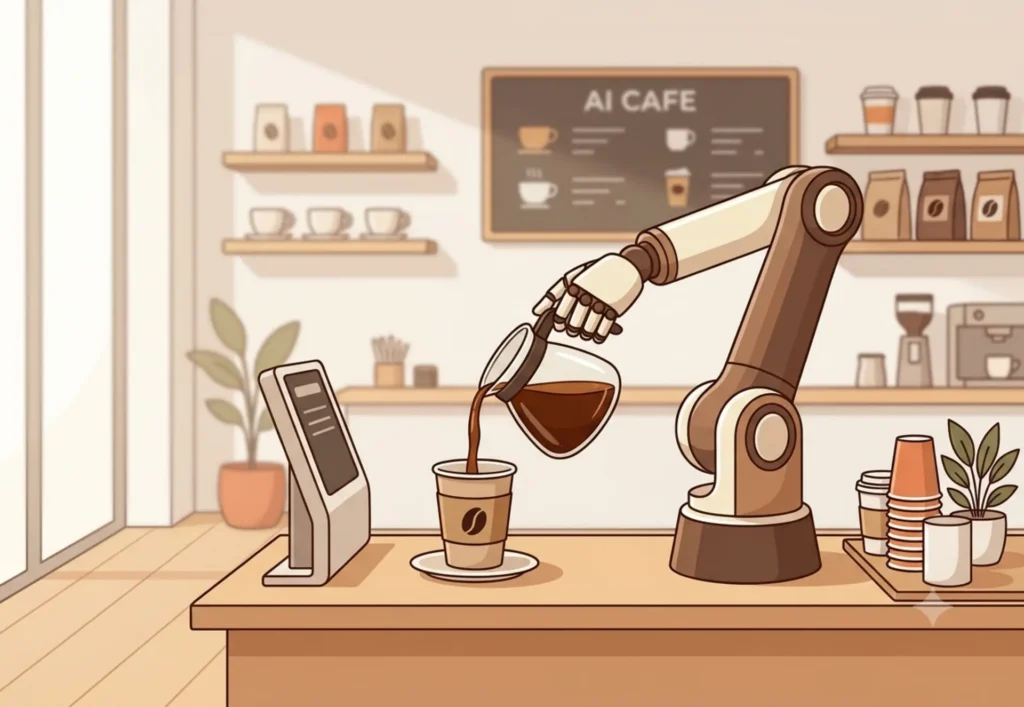
(The featured image was generated using Gemini’s AI tools for illustrative purposes only.)
[Reference]
1 “South Korean shops turn to robots, self-service to escape labour woes.” Reuters. https://www.reuters.com/world/asia-pacific/south-korean-shops-turn-robots-self-service-escape-labour-woes-2026-07-02/.\
2 “베이커리카페 창업 필수템 [AI 빵스캐너] 리뷰 인터뷰 #2 도아시스.” IMU POS. https://youtu.be/p7a8Vw9z9iE. https://www.youtube.com/watch?v=SICxewKoSv8.