

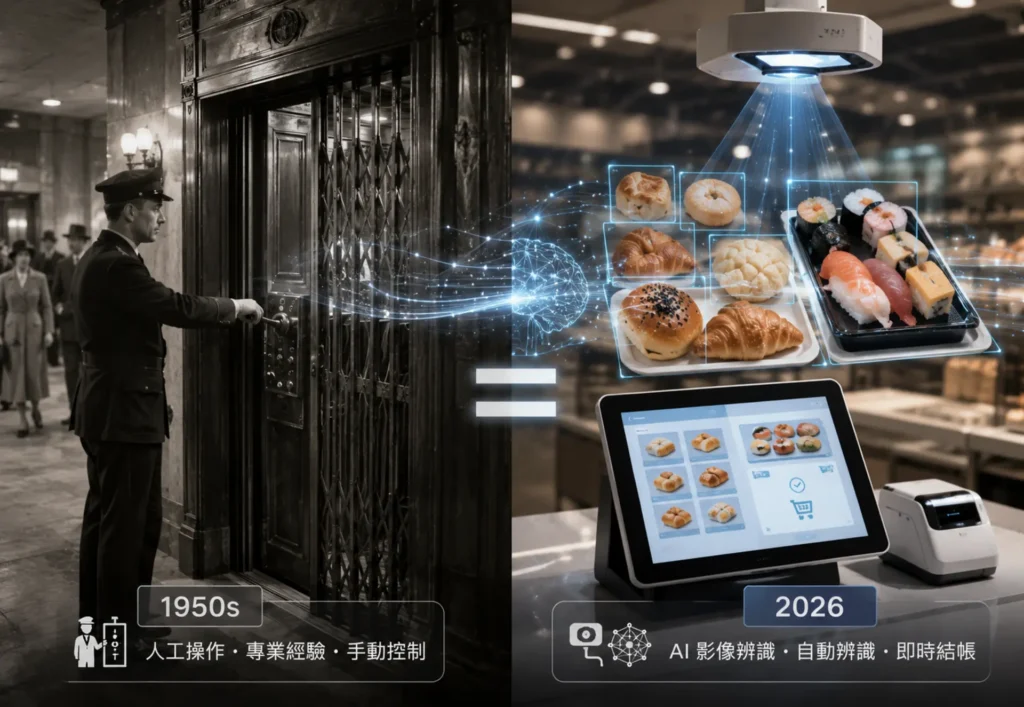
From Automatic Elevators to AI Image Recognition:
When Innovation Becomes Infrastructure
At Slush 2025, technology analyst and former Andreessen Horowitz (a16z) partner Benedict Evans shared a story that perfectly captures how breakthrough technologies become ordinary.
In 1950s Manhattan, apartment buildings employed elevator operators. Riding an elevator wasn’t as simple as pressing a button. Operators manually opened the gates, controlled the elevator with a lever, aligned it with each floor, and relied on skill and experience to make every trip safe and smooth.
Then automatic elevators arrived.
The technology frightened people. Elevator operators went on strike, and many passengers were uncomfortable trusting a machine to do what had always required a trained professional.
Today, that anxiety feels almost impossible to imagine.
Nobody says they’re riding an automatic elevator. It’s simply an elevator—a piece of infrastructure so familiar that the technology behind it has become invisible.
Evans also quoted AI pioneer Larry Tesler’s famous observation:
“AI is whatever machines can’t do yet.”
The moment a machine performs a task reliably, we stop calling it AI. It simply becomes part of how things work.
That same transition is now happening across food retail—from bakeries to supermarkets—with AI-powered image recognition.


Phase One: Retail’s “Manual Elevator”
Until recently, checkout and labeling depended on human expertise.
Cashiers had to recognize products by sight, especially in bakeries and fresh food departments where dozens of pastries or sushi varieties look nearly identical. Correctly identifying each item often came down to memory and experience.
Barcodes solved part of the problem—but not all of it.
Freshly baked bread, loose bakery items, and individual pieces of sushi are often difficult to label before they’re displayed. Staff still have to identify each item visually, locate it in the POS system, and select it manually.
Technology assisted the process, but humans remained at the center of every decision.
Phase Two: Retail Gets Its Automatic Elevator
Now computer vision is changing the workflow.
A customer places several different pastries on the checkout counter. An overhead camera scans them, and in less than a second the system identifies every item, calculates the total, and sends the transaction to checkout.
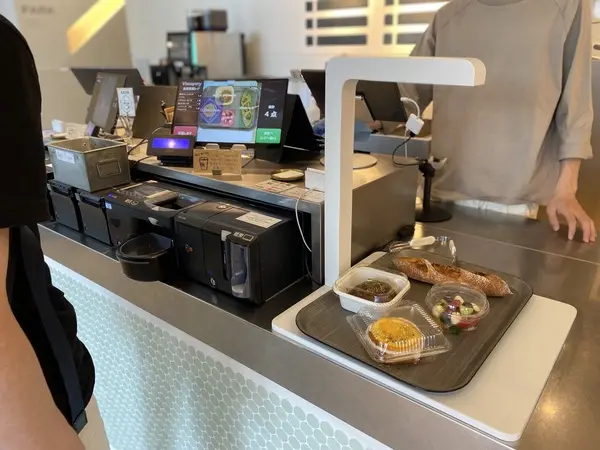
The same idea extends to self-service labeling.
A shopper places an individual piece of sushi beneath a camera, and the system instantly recognizes whether it’s salmon, tuna, or another variety before printing the correct price label. Even a tray containing multiple sushi types can be identified in a single scan.
For first-time users, the reaction is almost always the same:
“That’s amazing.”
It’s much the same reaction people had when they first saw an elevator operate without a human operator.
Further reading: A Japan delicatessen, THE BAKE STORE, enables AI Recognition on its iPad POS system
Further reading: AEON Japan Introduces AI Image Recognition for Bakery and Sushi Self-Service Labeling
Phase Three: From Skepticism to Trust
Every major technological shift goes through the same cycle. When automatic elevators were introduced, people worried they weren’t safe. Today, retailers ask similar questions about AI:
- Will it still identify the right product even if the bread looks a little different—for example, if it’s baked slightly darker than usual?
- Could premium sushi be mistaken for a lower-priced item?
Those questions don’t stop adoption—they drive improvement.
Just as elevators evolved with automatic brakes, safety locks, and countless engineering refinements, AI image recognition continues to improve through better models, larger training datasets, and real-world deployment.
As accuracy improves and both retailers and consumers see that AI can identify products several times faster than manual checkout, trust grows naturally.
When AI Becomes Invisible: The Moment Technology Becomes Everyday Infrastructure
We’re living through the period when AI still feels novel. That won’t last. Soon, even products without barcodes will be identified and checked out almost instantly. The experience will feel as natural as stepping into an elevator and pressing a floor button.
Before long, people won’t think about the AI behind the experience. They won’t call it “AI-powered checkout” or “computer vision.” It will simply be checkout—the way automatic elevators eventually became just elevators.
That’s the ultimate success of any technology: not that it impresses us, but that it disappears into everyday life. That’s when innovation becomes infrastructure.
(The featured image was generated using ChatGPT’s AI tools for illustrative purposes only.)
[Reference]
“AI Eats the World | Benedict Evans” Slush. https://www.youtube.com/watch?v=rTrFb-cSiwE.