

Labor Shortages Aren’t Going Away
How AI Is Helping Foodservice Operators Reduce Repetitive Work
For many foodservice operators, labor shortages are no longer a short-term disruption. They’ve become part of daily operations.
Hiring is harder. Turnover remains high. Training takes time. And even when teams are fully staffed, it is difficult to maintain consistent speed and service quality during peak hours.
That pressure shows up in the same places: longer checkout lines, more order mistakes, slower throughput, and exhausted staff trying to keep up with demand.
As a result, many operators are asking a more practical question: What parts of foodservice operations still need to be handled manually—and what can be supported by automation?
Increasingly, AI is being applied to exactly that gap.
The Real Bottleneck Is Repetition, Not Just Headcount
When people talk about labor shortages, the conversation usually focuses on staffing levels. But in day-to-day operations, the bigger issue is repetition.
Staff spend most of their shift doing the same set of tasks over and over again: identifying menu items, entering orders into POS systems, answering routine questions, managing queues, and handling payment confirmations.
Individually, these tasks may seem simple. Collectively, they consume a significant amount of time and attention.
These interactions are necessary, but they are highly repetitive and follow predictable patterns—making them well suited for automation and system support.
As a result, many foodservice operators are introducing self-service and AI-assisted systems to reduce the load on frontline staff.
1. AI Food Recognition and Checkout
One of the clearest examples is checkout in cafeteria-style environments. In settings like corporate dining halls, self-service canteens, and institutional cafeterias, staff often need to:
- Identify items on a tray
- Enter products into a POS system
- Look up prices
- Confirm the final order before payment
As menu complexity increases, this becomes a real bottleneck during peak service periods.
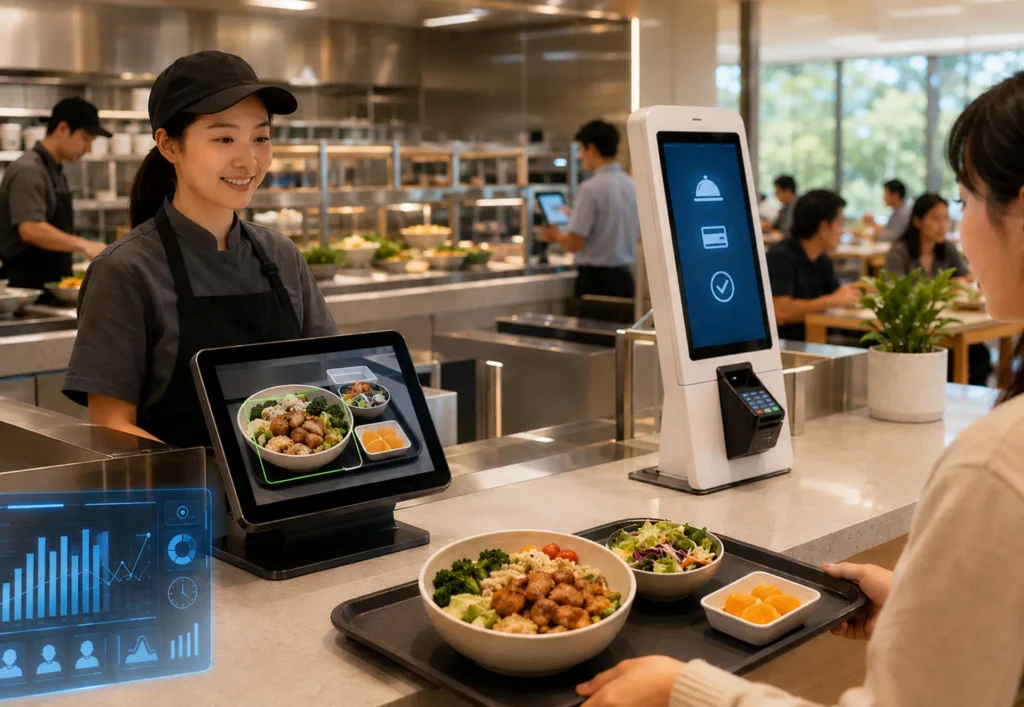
AI-powered food recognition systems can identify items directly from a tray and map them to the correct menu entries in real time.
The result is not just faster checkout. It also reduces repetitive manual identification and data entry, allowing staff to move customers through the line more efficiently.
2. Self-Service
Another major source of operational load is customer flow. Staff are constantly managing lines, guiding guests, and answering the same set of questions throughout the day:
- Is this dine-in or takeaway?
- Are you a member of our loyalty program?
- Would you like to add today’s special?
- How would you like to pay?
These interactions are predictable and repeatable, but they still consume a significant amount of time during peak hours. To reduce this operational load, some operators are adopting self-service kiosks with AI-assisted item recognition.
The goal is not to remove staff from the experience. It’s to remove repetitive steps so staff can focus on service, food quality, and resolving exceptions instead of processing routine transactions.
3. Operational Data and Performance Insights
Foodservice operations generate large volumes of data every day, but most of it is never fully used. Common questions often go unanswered:
- When are our peak service hours?
- Which menu items sell the most?
- What items frequently run out?
- Where do order errors happen most often?
- How long does each transaction take?
Traditionally, answering these questions required manual reporting or experienced managers relying on memory and observation.
Today, AI-powered platforms can automatically collect and organize this data in the background.
This enables operators to identify operational trends, improve decision-making, and ultimately improve efficiency without adding administrative burden.
The Future of Foodservice Is Human + AI, Not Automation Alone
Despite rapid advances in automation, foodservice is not moving toward a fully autonomous model. Human staff remain essential for hospitality, judgment, and handling real-world exceptions that systems cannot fully anticipate.
AI, on the other hand, is strongest in structured, repetitive environments where speed and consistency matter.
In practice, this creates a clear division of labor.
AI handles identification, processing, and routine workflows. Staff focus on guest experience, quality control, and operational oversight.
The most effective implementations are not the ones that replace people. They are the ones that remove repetitive work, reduce operational friction, and make daily service more consistent.
Ultimately, AI is not changing the role of people in foodservice. It is changing how much of their time is spent on work that actually requires them.
(The featured image was generated using ChatGPT’s AI tools for illustrative purposes only.)