

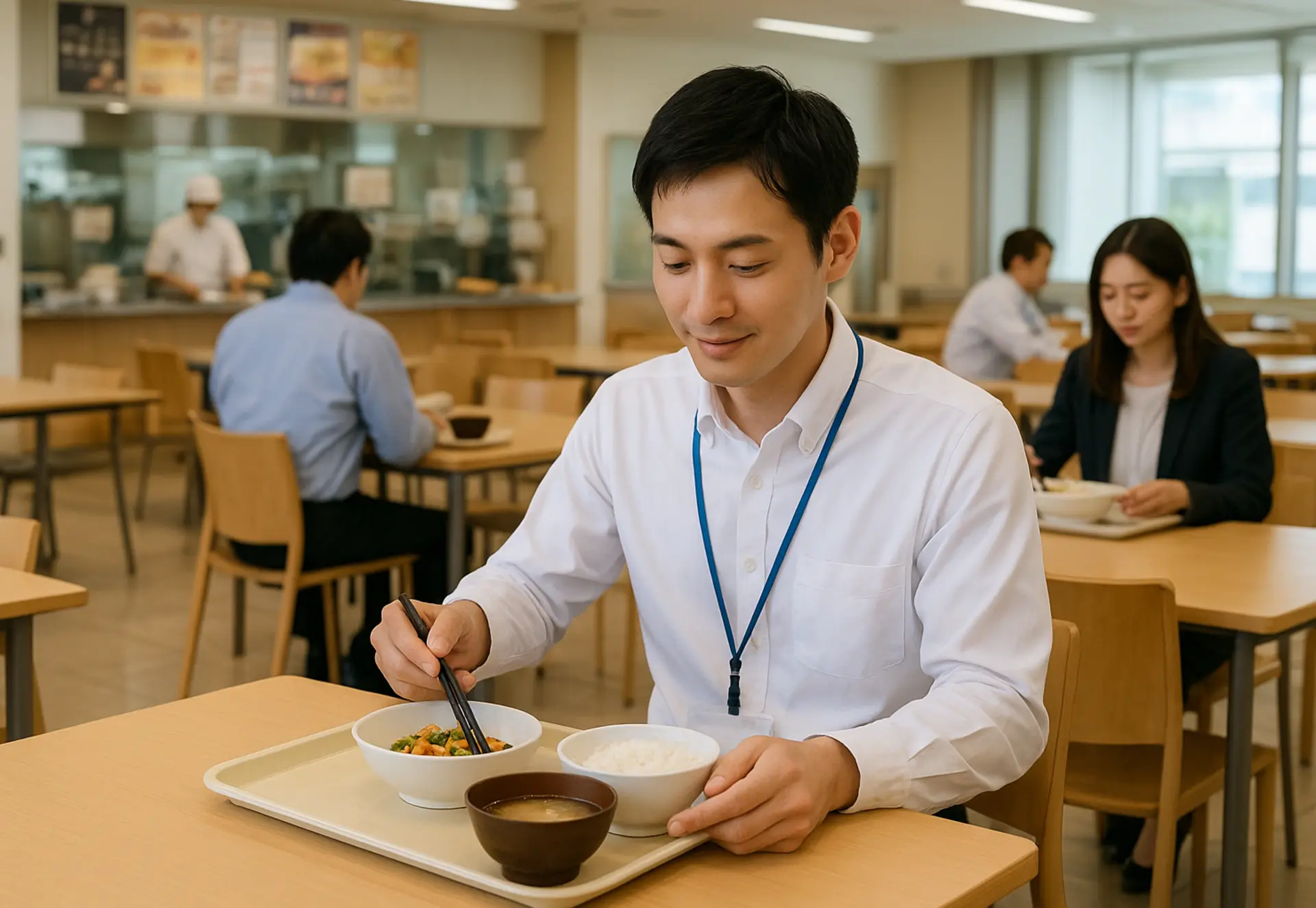
More Than Just a Cafeteria:
How AI is Reimagining Japan’s Corporate Cafeteria
Trends in Japanese Employee Cafeterias
In Japan, the corporate cafeteria—or shain shokudo—has evolved far beyond a simple dining hall. Today, it serves as a critical benchmark for employee perks and overall quality of life. As work-life dynamics shift and the cost of living continues to climb, corporate investment in dining benefits has moved into the spotlight.
According to a report by Fuji Keizai, while the corporate cafeteria market contracted during the pandemic, it has since shown steady recovery. The market size dropped 20% to approximately ¥909.6 billion in 2020 compared to the previous year but rebounded to around ¥972 billion by 2024, with expectations to maintain this level into 2025. This trend reflects employees returning to office work post-pandemic and companies’ renewed emphasis on employee welfare 1.
Furthermore, a study by the Nutrition Science Journal found that 27% of respondents now have access to an on-site cafeteria 2. Data from the Japan Food Service Association (JF Network) further confirms that these facilities are capturing a larger share of the overall food service industry, signaling a significant uptick in corporate demand and investment 3.
Market Drivers: Rising Health Awareness and Eating-Out Costs
Faced with the dual pressures of rising inflation and a growing emphasis on health, more companies are leveraging their cafeterias as one of the strategies for talent retention and employee satisfaction.
According to recruitment platform surveys, the average cost of dining out for lunch in Japan has risen steadily for several years. By providing nutritious, affordable meals, companies can effectively ease the financial burden on their staff—making them far more attractive to top-tier talent.
Beyond just nutrition, many forward-thinking companies are reinventing these spaces as “social hubs.” By offering light snacks and even alcoholic beverages in the evenings, they are transforming cafeterias into communal areas that foster internal communication and strengthen corporate culture.
Digital Transformation of Employee Cafeterias with AI
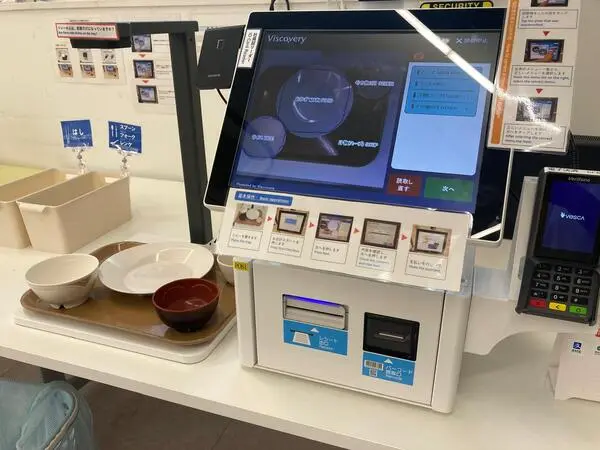
Staffing a cafeteria for manual checkout often proves cost-inefficient. In pursuit of operational efficiency, some companies have implemented RFID-based systems that embed chips in dishes for self-checkout. However, RFID systems carry high upfront costs, and maintenance and chip replacement expenses can be substantial.
With technological advances, AI-powered image recognition has emerged as a more effective solution. This technology can accurately identify a wide variety of dishes and meals, overcoming the cost and operational limitations of RFID while alleviating workforce constraints.
This “ultra-fast checkout” model not only enhances the dining experience for employees but also has the potential to extend to industrial park cafeterias, campus dining halls, and chain or smart restaurants, serving as a cornerstone for digitalized foodservice operations.
Key applications include:
- Industrial Parks & Large Enterprises Cafeterias: Streamlining high-volume traffic with rapid checkout and precise cost control.
- Schools & Campus Dining Halls: Replacing manual checkout processes to modernize the students’ dining experience.
- Restaurant Chains & Smart Dining Venues: Integrating ordering, payment, and self-service workflows to boost efficiency and ensure standardized quality.
Further Reading:
- The Rise of Self-Service Dining in Japan: From Meal Ticket Machines to RFID and AI-Powered Checkout
- AI Revolutionizes Haidilao “Hi Noodle” Self-Checkout Experience
- Real-World Challenges in AI Food Recognition (Part 1)
- Real-World Challenges in AI Food Recognition (Part 2): How AI Identifies Cups and Plates? (Tableware Recognition)
- From Retail to Dining: How AI Image Recognition Solves Checkout Challenges for Unpackaged Goods
- 5 Innovative Image Recognition Applications in Food Service
[References]
1 “‘Lunch Is Too Expensive, So I Skip Meals’: Japanese Companies Introduce 5,000-Won Buffets in Response to Office Workers’ Concerns.” The Asia Business Daily. https://www.asiae.co.kr/en/article/2025101309324293025.
2 〈社員食堂の設置・利用状況と利用に関連した社会人口統計学的要因および理由〉、J-STAGE。 https://www.jstage.jst.go.jp/article/eiyogakuzashi/83/2/83_78/_article/-char/ja.
3 《JF MONTHLY 2024年10月号(通巻497号)》、一般社団法人日本フードサービス協会。https://www.jfnet.or.jp/wp/wp-content/uploads/2025/08/JFM2024_10.pdf.