

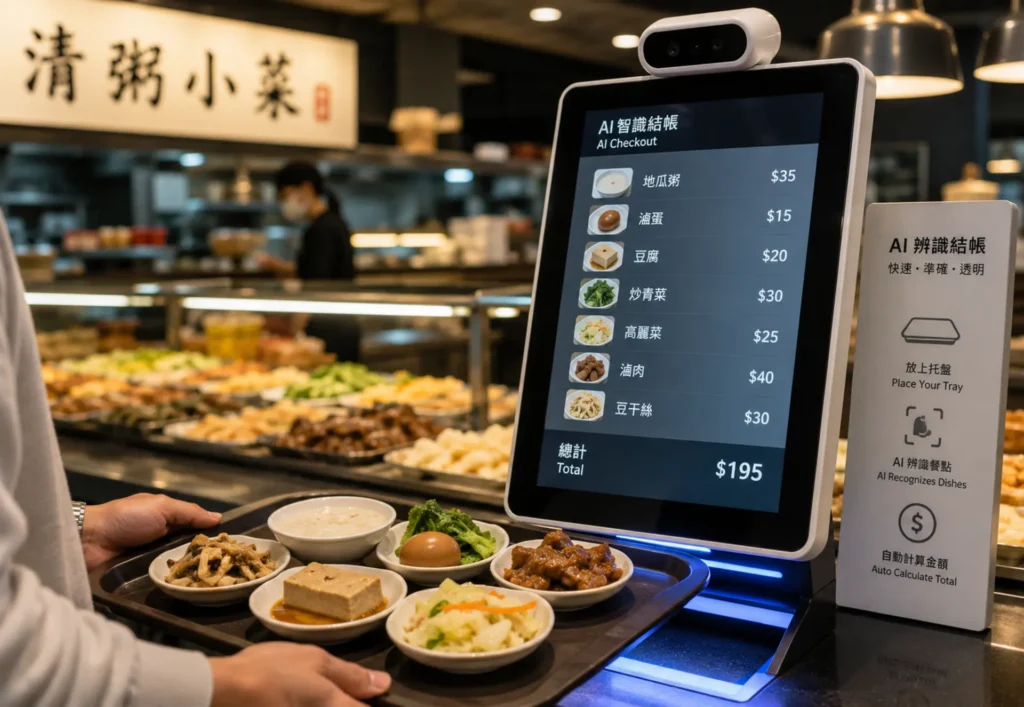
AI Checkout Is Coming to Taiwan’s Porridge Buffet Restaurants
Traditional Dining Is Quietly Going Digital
In Taiwan, qingzhou xiaocai restaurants — casual porridge buffet eateries filled with small side dishes — have long been part of everyday life.
Late-night bowls of congee, brightly lit storefronts, steaming sweet potato porridge, and rows of dishes customers can freely mix and match have made this dining style a familiar part of Taiwanese food culture. Somewhere between home cooking and eating out, these restaurants are loved for their flexibility and variety.
But behind the scenes, they have always been difficult to operate efficiently.
Why Porridge Buffets Are So Hard to Operate
Unlike fast-food chains or restaurants with fixed meal sets, every customer tray at a qingzhou xiaocai restaurant is different. One customer may choose vegetables, tofu, braised eggs, and porridge, while another may only take a few side dishes with rice. Because there are no fixed combinations, checkout has traditionally relied heavily on experienced staff who can quickly recognize dishes and calculate prices from memory.
Many restaurants still depend on manual pricing, with employees visually estimating dishes, entering items by hand, and confirming totals with customers. During busy meal periods, this often leads to long lines, inconsistent checkout speeds, and longer training times for new employees.
That is beginning to change.
AI Is Changing the Checkout Process
As AI food recognition technology becomes more advanced, these restaurants are finding new ways to improve checkout operations. Modern AI systems can now identify dishes based on their appearance, plating, and containers, even when multiple items are placed together on the same tray.
After a customer places their tray in the scanning area, the system can automatically recognize the dishes and calculate the total price within seconds. This reduces manual work at the register and helps checkout move faster during peak hours. For customers, the difference is simple: shorter lines and a smoother checkout experience.
For restaurant owners, AI can reduce dependence on highly experienced cashiers while lowering pricing errors and operational pressure.
Labor Shortages Are Reshaping Restaurant Operations
This shift is happening at a time when Taiwan’s restaurant industry is facing growing labor shortages. Porridge buffet restaurants are especially affected because they handle large numbers of dishes in fast-paced environments where customer traffic is heavily concentrated during meal times. Even when kitchens can keep up with demand, checkout bottlenecks can still slow down the entire operation.
As a result, more restaurant operators are beginning to see AI not as a replacement for staff, but as a tool that helps employees focus on more valuable tasks like serving customers, restocking dishes, maintaining cleanliness, and improving the overall dining experience.
The human side of these restaurants is not disappearing. The warmth still comes from the people, the atmosphere, and the familiar connection with regular customers. What AI changes is the efficiency behind the counter.
A Traditional Industry Begins to Change
Beyond qingzhou xiaocai restaurants, AI food recognition is also expanding into cafeterias, school dining halls, hospital food courts, bakeries, supermarket prepared-food sections, and other high-traffic dining environments where fast checkout matters.
For many food businesses, future competition may no longer depend only on the food itself, but also on who can operate more smoothly with limited staffing.
What once seemed like a highly traditional corner of Taiwan’s food culture is now becoming part of the country’s broader digital transformation. And as more restaurants adopt AI-powered checkout systems, qingzhou xiaocai may become one of the clearest examples of how technology is quietly reshaping everyday dining in Taiwan.
(The featured image was generated using ChatGPT’s AI tools for illustrative purposes only.)